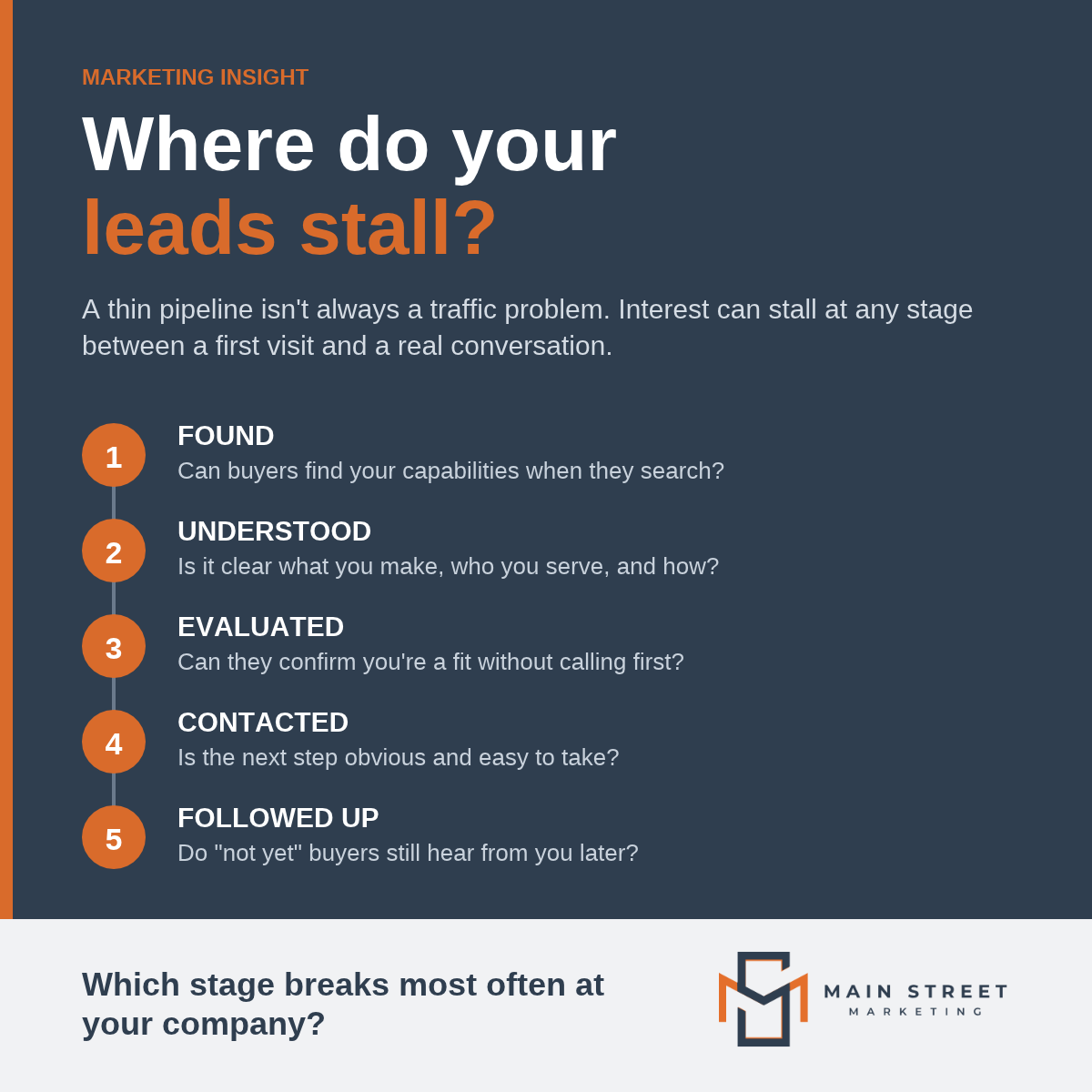
When a manufacturer’s pipeline runs thin, the usual response is to go looking for more traffic. But often the interest already exists, and it stalls somewhere between a buyer’s first search and a qualified conversation. This five-stage review shows where inquiries get stuck and what to fix first before you plan 2027 marketing.
Key Takeaways
A break at any stage thins the pipeline as much as low traffic does.
Each stage answers a specific buyer question, and each has signs you can check.
Fix the weakest stage before adding visibility on top of it.
A Thin Pipeline Isn't Always a Traffic Problem
Every inquiry passes through a sequence. A buyer has to find you, understand what you do, evaluate whether you’re a fit, decide to reach out, and then be handled well enough that the conversation keeps moving.
A break at any point thins the pipeline as much as low traffic does. Adding visibility on top of a weak stage only puts more buyers in front of the same gap.
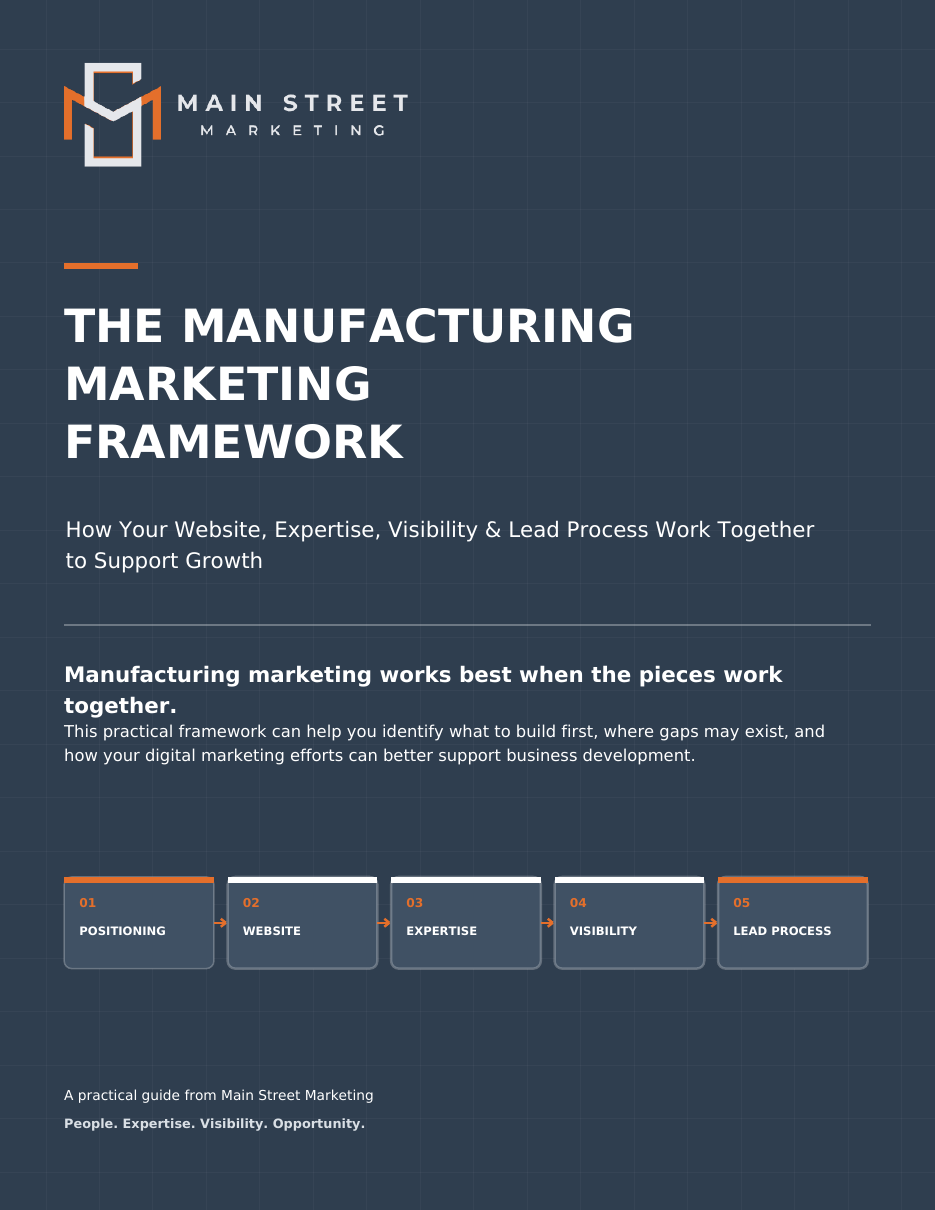
As 2027 budgets come together, it’s worth reviewing that path before deciding where to invest. The review below follows the five parts of our Manufacturing Marketing Framework: positioning, website, expertise, visibility, and lead process. For each one, you’ll find the question buyers are trying to answer, the signs that it may be your bottleneck, and what to fix first.
1. Positioning: Be Understood
The buyer’s question: “Is this company relevant to what I need?”
Positioning is the clarity behind everything else you publish. Without it, your website, content, and outreach each describe the company a little differently, and buyers have to work out on their own whether you’re right for their project. Many won’t take the time.
Signs this is your bottleneck:
Your homepage could describe several competitors if you swapped the logo.
Sales spends early calls explaining what you do instead of discussing the buyer’s project.
You get more inquiries for work you don’t want than for the work you do best.
What to fix first: Write down, in plain language, who you serve best, which problems or applications you solve, and why a buyer should consider you. Get leadership, sales, and engineering to agree on it before it goes on the website. That statement becomes the filter for every page, post, and campaign that follows.
2. Website: Be Evaluated
The buyer’s question: “Can I tell whether they can handle my project without calling them first?”
Engineers, purchasing teams, and owners do much of their research before they reach out. A buyer shouldn’t need a sales conversation just to understand the basics of your business. If your website can’t answer their early questions, they move on to a supplier whose site can, and you never learn they were looking.
Signs this is your bottleneck:
Buyers have to contact you to learn your core capabilities, materials, processes, or industries served.
Important details live only in a PDF brochure, an equipment list, or photo captions.
Visitors can’t easily find your quality standards, technical information, or what happens after they submit a request.
The next step is vague, buried, or limited to a generic contact form.
What to fix first: Start with the pages buyers use to evaluate you: one page per core capability, your industries or applications, quality, and a clear path to request a quote. Check each against the questions buyers ask most. If an answer only exists in someone’s head or a sales deck, it belongs on the site.
3. Expertise: Be Useful
The buyer’s question: “Does this company understand problems like mine?”
Most manufacturers know far more than their marketing shows. Engineering knows the technical details. Sales hears the same customer questions every week. Operations understands the processes, limits, and real-world applications.
When that knowledge stays inside the building, buyers can’t see it, and your company looks interchangeable with everyone else who lists the same equipment.
Signs this is your bottleneck:
Your content says what you do but rarely explains how or why.
Sales answers the same questions over and over, and none of those answers appear on your website.
Your blog and social channels go quiet for months or carry mostly announcements.
What to fix first: Ask sales and engineering one question: “What do prospective customers ask you over and over?” Turn the most common answers into FAQs, application pages, or short articles. You don’t need to invent expertise. You need to make the expertise you already have easier to find and understand.
“Adding visibility on top of a weak stage only puts more buyers in front of the same gap.”
4. Visibility: Be Found
The buyer’s question: “Who can do this?”
Buyers start their research in many places: search engines, AI research tools, LinkedIn, industry platforms, and referrals. Visibility is what puts your company in that research.
It works best once the earlier stages are solid, because it sends buyers to what you’ve already built. Visibility pointed at an unclear website only multiplies the problem.
Signs this is your bottleneck:
Most new business comes from referrals or people who already know your name, and searches for your capabilities rarely bring buyers to you.
Your capabilities are described in images, PDFs, or general language that search engines and AI tools can’t easily interpret.
Website traffic is growing but inquiries aren’t, and you can’t tell where visitors come from.
What to fix first: Give each core capability its own page, with descriptive headings and specific text instead of images or downloads alone. Then extend visibility outward through search, LinkedIn, and the industry channels your buyers use. No one can guarantee placement in search results or AI answers, but clear, specific, well-structured information gives every platform more to work with.
5. Lead Process: Be Ready to Respond
The buyer’s question: “Will this company take my inquiry seriously?”
Marketing can produce inquiries, downloads, and quote requests, but those aren’t revenue. What happens after a prospect raises a hand decides whether interest becomes an opportunity.
In long manufacturing buying cycles, many good prospects aren’t ready to buy the first time they reach out. How you handle them matters as much as how you handle the ones who are.
Signs this is your bottleneck:
No one can say how many inquiries came in last quarter or what happened to them.
Your forms ask so little that every inquiry needs a discovery call to sort out, or so much that serious buyers give up partway.
A “call us next quarter” response is treated as a dead lead rather than tracked.
What to fix first: Map what happens between a form submission and a qualified conversation: who receives the inquiry, how fit and timing are judged, and how prospects who aren’t ready yet are followed up. Fix the first gap you find. A clear process turns lead generation from activity into progress.
Where to Start in 2027
The right first step depends on where your company is today.
If you’re starting from scratch: clarify your positioning, strengthen your core website pages, then capture the questions buyers ask most.
If you already have a solid website: turn internal expertise into useful content, improve search and digital visibility, then make next steps clearer.
If you’re already generating inquiries: review ownership, response time, qualification, follow-up, and how you measure results.
This week, pick the stage that sounds most familiar and check it against the signs above. You may not need more marketing activity. You may need a stronger connection between the marketing you already do and the business development it’s meant to support.
FREE GUIDE
The Manufacturing Marketing Framework
Learn how your website, expertise, visibility, and lead process work together to support growth, and which part needs attention first.
The 5 parts of a connected marketing system
What to build first and where gaps may exist
A quick self-check for your website foundation
ABOUT THE AUTHOR
Christine O'Neill
Christine is the owner and founder of Main Street Marketing in White Bear Lake, Minnesota. Since 2019, she has helped manufacturers and industrial companies build stronger brands, better websites, and consistent lead generation.